

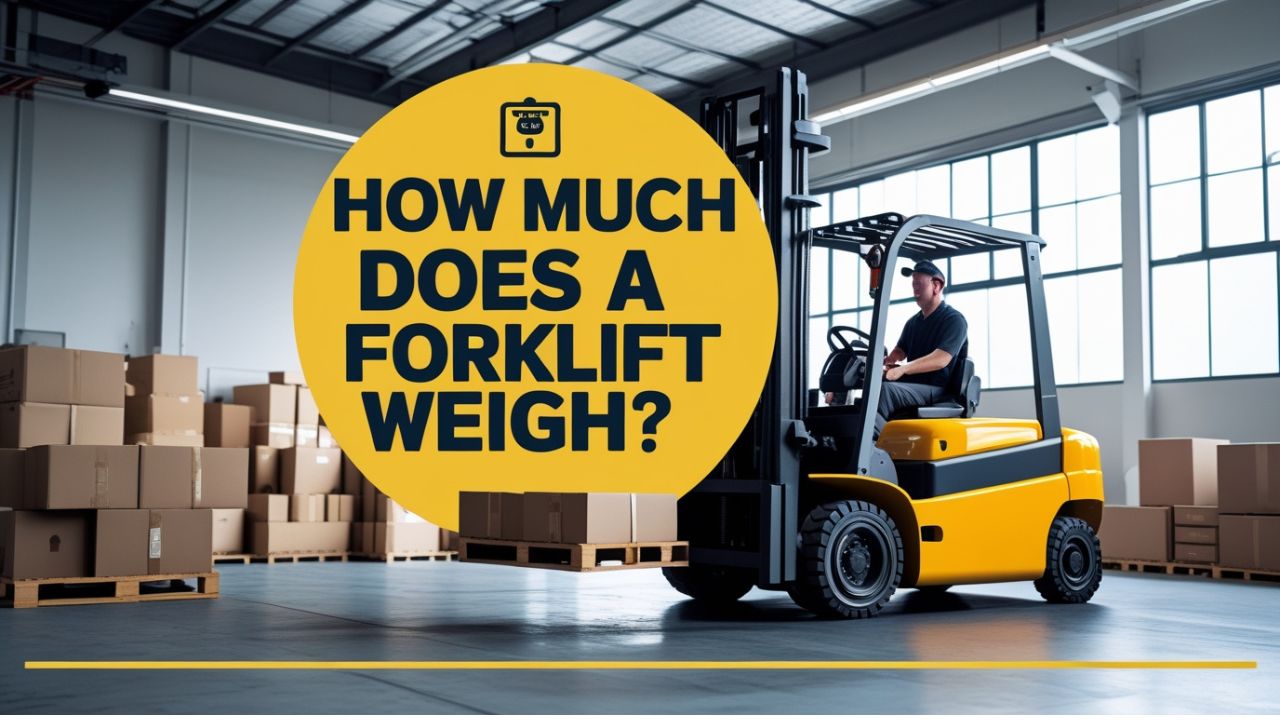

Forklift weight matters. It affects floor load, transport, and safety. People ask this when planning a warehouse, ordering ramps, or moving equipment. This guide gives clear, short answers. Read the ranges, a simple example, and practical tips.
Typical weight ranges by type
- Manual pallet jack (hand jack): 50 to 150 kg. Very light and simple.
- Electric pallet jack: 150 to 600 kg. Battery and motor add weight.
- Small electric counterbalance (1–2 tonne capacity): about 2,000 to 3,000 kg.
- Standard counterbalance (2–3.5 tonne): about 3,000 to 4,500 kg.
- Large counterbalance (4 tonnes and above): from 4,500 kg to 10,000+ kg. Options and attachments change this.
- Reach truck: about 2,500 to 4,000 kg. Built for high racking.
- Side loader: from 4,000 kg to 12,000+ kg, depending on carriage and capacity.
- Rough-terrain forklift: about 3,500 to 9,000 kg. Heavy tyres and stronger frames add mass.
- Telehandler (telescopic handler): often 4,000 to 12,000+ kg. They can be heavier than counterbalance trucks with similar lift ratings.
These are broad ranges. Models and manufacturers vary. Always check the exact spec plate for a machine.
What adds weight to a forklift?
- Counterweight. A big block at the back to balance loads.
- Battery. Large lead-acid or lithium packs are heavy.
- Mast height and reinforcement. Taller or stronger masts weigh more.
- Attachments. Clamps, rotators, fork positioners add mass.
- Tyres and chassis. Pneumatic tyres and heavy frames add weight for rough work.
- Engine and fuel systems. Diesel or LPG machines carry engines and tanks.
Small options often add hundreds of kilograms. Big attachments can add more.
Example: calculating point load (simple)
You may need to know how much weight presses down under a wheel. Here is a clear example done step by step.
- Take the truck’s operating weight. Use 4,000 kg as an example.
- Estimate that 60% of the weight sits on the front axle. To find 60% of 4,000 kg, multiply 4,000 by 0.6. Do it step by step:
- 4,000 × 0.6 = (4,000 × 6) ÷ 10.
- First, 4,000 × 6 = 24,000.
- Then, 24,000 ÷ 10 = 2,400 kg on the front axle.
- 4,000 × 0.6 = (4,000 × 6) ÷ 10.
- If two front wheels share that axle load equally, divide 2,400 by 2:
- 2,400 ÷ 2 = 1,200 kg per front wheel.
- 2,400 ÷ 2 = 1,200 kg per front wheel.
So each front wheel might press about 1,200 kg into the floor. Engineers use numbers like this to check slab strength and ramp capacity.
Transport and site planning
- Trailers: Know the truck’s weight before loading it on a trailer. Use a weighbridge if unsure.
- Permits: Heavy machines sometimes need road permits or special handling. Check local rules.
- Ramps and plates: Match their rated capacity to the truck and to point loads under wheels.
- Floor checks: Concrete slabs are rated by load per square metre and by point loads. Consult an engineer for heavy use.
Buying, renting, and operations
- Renting: Rent if work is temporary. You can pick a lighter model for indoor floors.
- Buying: Buy if you need regular daily use. Plan floors, chargers, and transport around exact weights.
- Battery logistics: For electric trucks, spare batteries or fast chargers affect handling and weight planning.
- Attachments: Add the weight of attachments when you compare trucks to floor or trailer limits.
Weight terms explained
Manufacturers use terms you may see on spec sheets. Know these simple definitions.
- Curb weight: The weight of the truck without operator and load. It often includes standard attachments.
- Operating weight / service weight: The truck ready to work. It usually includes battery or full fuel and standard equipment.
- Rated capacity: The maximum load you can lift safely at a given load centre. This is not the truck’s weight.
Always confirm which term the dealer uses.
Quick operator tips
- Do a daily walk-around and check for visible damage.
- Keep batteries and fuel levels consistent when planning transport weights.
- Label trucks with their curb or operating weight where practical. This helps loaders and drivers.
- Don’t fit attachments for a single lift unless you need them. They add weight and complexity.
Final checklist before use
- Check the data plate for service or operating weight.
- Ask what the spec includes (battery, fuel level, standard forks).
- Calculate point loads for floors and ramps.
- Weigh the truck on a certified scale for transport if weight is critical.
FAQ
Q: How heavy is a typical 3-tonne forklift?
A: A 3-tonne capacity counterbalance usually weighs between about 3,000 and 4,500 kg. Battery type, mast height, and attachments are the main reasons weight varies. Check the spec plate for exact numbers.
Q: Can a heavy forklift break concrete floors?
A: Yes. If the slab or its finish is not rated for the truck’s point load, it can crack or spall. For frequent heavy use, get the floor’s design load and consult a structural engineer.
Q: Do attachments change safe lift limits?
A: Yes. Attachments add weight and change the truck’s centre of gravity. That reduces the safe lift capacity. Recalculate safe loads and follow the manufacturer’s guidance.


