

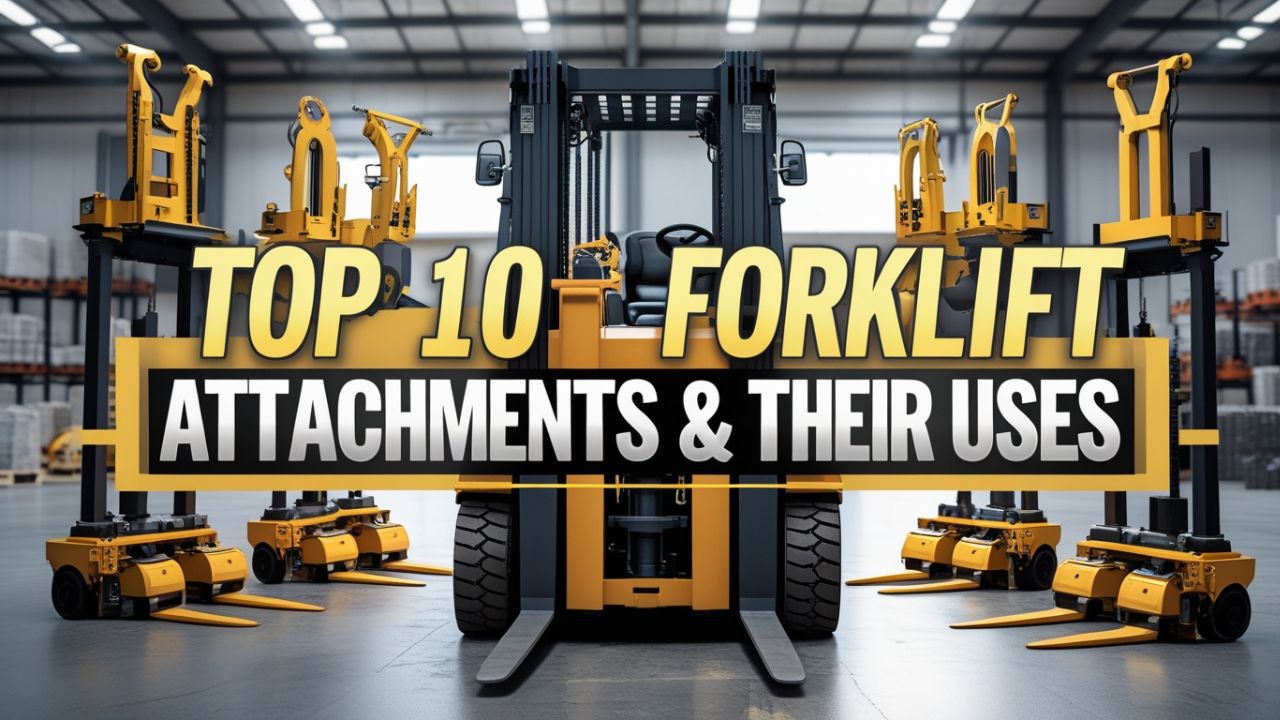
Top 10 Forklift Attachments & Their Uses — Complete Guide

Attachments let a forklift do more than lift pallets. They help move drums, rolls, cartons and odd shapes. They also change how the truck handles and how much it can lift.
Top 10 attachments (what they do and when to use them)
Here are ten common attachments you’ll see on job sites and in warehouses. Use the right one for the load and the job.
- Fork extensions
- Slide over the forks to reach long loads.
- Good for occasional long loads. Note: extensions move the load center and reduce rated capacity.
- Slide over the forks to reach long loads.
- Side shifter
- Moves forks left and right without moving the truck.
- Saves time when aligning with pallets or racks.
- Moves forks left and right without moving the truck.
- Fork positioner
- Adjusts fork spacing from the cab.
- Useful when you handle mixed pallet sizes or non-standard pallets.
- Adjusts fork spacing from the cab.
- Push–pull
- Handles loads on slip sheets rather than pallets.
- Common in food, beverage, and retail distribution. Confirm slipsheet use before you buy.
- Handles loads on slip sheets rather than pallets.
- Rotator
- Rotates the forks or load.
- Handy for tipping bins or discharging loose product into hoppers.
- Rotates the forks or load.
- Drum handler
- Designed to lift and secure steel or plastic drums.
- Safer and faster than manual handling for barrels.
- Designed to lift and secure steel or plastic drums.
- Clamp attachments (carton, paper roll, bale)
- Grip loads without forks.
- Used for paper mills, recycling, whitegoods and textiles.
- Grip loads without forks.
- Carpet pole / roll handler
- Long pole that carries carpet rolls or fabric rolls.
- Lets you move bulky rolls without crushing them.
- Long pole that carries carpet rolls or fabric rolls.
- Jib boom / lifting boom
- Turns the forklift into a short crane.
- Good for lifting engines, machinery or awkward items at a distance.
- Turns the forklift into a short crane.
- Personnel platform (work platform)
- A platform designed to lift people for maintenance tasks.
- Only use units made for personnel and follow safety rules.
How to pick the right attachment
- Match the attachment to the load type and shape. Keep it simple.
- Check capacity charts. Attachments change the truck’s rated capacity.
- Get written approval when a modification affects the truck’s safe operation. OSHA and manufacturers require this in many cases.
- Ask suppliers for site demos. Try the attachment with your pallets and aisles.
- Think about maintenance: seals, hydraulics, and spare parts matter.
Safety and maintenance — short checklist
- Train operators on each attachment. Attachments change handling and visibility.
- Inspect attachments daily. Look for cracks, loose pins, and hydraulic leaks.
- Update data plates or load charts when an attachment changes lift characteristics.
- Use attachments only within rated limits. Don’t guess.
- Keep a maintenance log for attachment repairs and inspections.
When to rent vs buy
- Rent for short projects or seasonal peaks. It’s fast and lowers upfront cost.
- Buy if you use the attachment often. Buying can be cheaper over time.
- Check battery life, frame wear, and whether the attachment fits several truck types.
FAQs
Q: Do attachments change how much my forklift can lift?
A: Yes. Adding weight or changing the load center reduces rated capacity. Check the truck’s new load chart or get written approval from the manufacturer.
Q: Can any operator use a new attachment without retraining?
A: No. Operators must be trained on the specific attachment and evaluated before using it. Training should include hands-on practice.
Q: Are there attachments for cold stores or food areas?
A: Yes. Many attachments come with cold-store kits or stainless contact surfaces for hygiene. Ask the supplier for food-grade options.


