

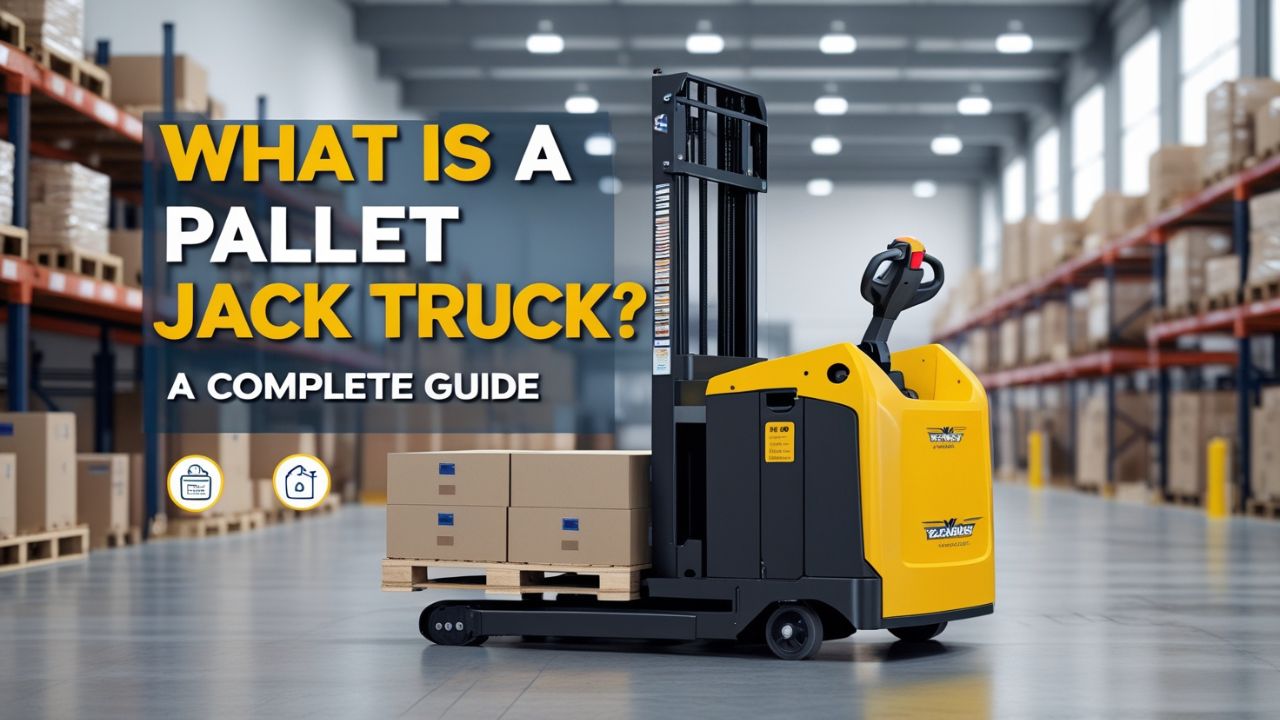

In every warehouse, retail store, or loading dock, you’ll notice a simple but powerful tool: the pallet jack truck. While forklifts usually steal the spotlight, pallet jacks are often the real workhorses behind smooth material handling. They may look basic, but they play a crucial role in moving goods safely and efficiently.
So, what exactly is a pallet jack truck, and how does it work? Let’s break it down.
What is a Pallet Jack Truck?
A pallet jack truck—also known as a pallet jack, pallet truck, or pump truck—is a tool used to lift and move pallets over short distances. It’s the simplest type of forklift, designed to slide its forks under a pallet, lift it slightly off the ground, and move it to another spot.
Instead of replacing forklifts, pallet jacks complement them. Where forklifts handle heavy lifting and stacking, pallet jacks shine in tighter spaces and quick moves.
How a Pallet Jack Works
A pallet jack is straightforward to use:
- Insert the forks under the pallet.
- Pump the handle to activate the hydraulic system, which raises the forks a few inches.
- Move the load by pushing or pulling the jack to its new location.
- Lower the pallet by releasing the handle.
That’s it—no complex controls or training required.
Types of Pallet Jacks
Not all pallet jacks are the same. Businesses choose different types depending on load weight, working environment, and budget.
1. Manual Pallet Jack
- Operated entirely by hand
- Affordable and low maintenance
- Best for lighter loads and smaller spaces
- Common in small warehouses, shops, and delivery trucks
2. Electric Jack Pallet Trucks (Powered Pallet Truck)
- Runs on a rechargeable battery
- Requires less physical effort
- Can handle heavier loads
- Ideal for large warehouses with frequent movement
3. Specialized Pallet Jacks
- High-lift pallet jacks – raise pallets higher for easier handling
- Stainless steel pallet jacks – used in food and pharmaceutical industries where hygiene matters
- Weighing pallet jacks – come with built-in scales to measure load weight instantly
Advantages of Using a Pallet Jack Truck
So why do so many businesses rely on pallet jacks? Here are some clear benefits:

✅ Cost-Effective
Compared to forklifts, pallet jacks are much cheaper to buy or rent. Even powered versions cost less than a forklift.
✅ Easy to Use
No special license or training is required for manual pallet jacks. With electric models, basic instruction is usually enough.
✅ Maneuverability
Their small size makes them perfect for narrow aisles, small warehouses, or crowded retail areas.
✅ Low Maintenance
Manual pallet jacks have very few parts to maintain. Even electric ones are simpler and cheaper to maintain than forklifts.
✅ Safety
Since they don’t lift loads high off the ground, pallet jacks reduce the risk of falling items compared to forklifts.
When to Use a Jack Pallet Trucks
A pallet jack may not replace a forklift, but it’s the smarter choice in certain situations. You’ll want one if you:
- Need to move goods across short distances
- Work in tight spaces or narrow aisles
- Handle moderate load weights (2,000–5,500 lbs)
- Want a low-cost material handling option
For example, if you run a retail store receiving weekly shipments, a pallet jack is enough. But if you’re managing a large warehouse with heavy stacking needs, you’ll need forklifts in addition.
Pallet Jack vs. Forklift: What’s the Difference?
It’s common to confuse pallet jacks with forklifts since both move pallets. But here’s the key difference:
- Pallet Jacks – Move pallets on the ground, short distances, lighter loads, no stacking.
- Forklifts – Lift pallets high, transport longer distances, handle heavier loads, good for stacking and large operations.
Think of pallet jacks as the “everyday tool” and forklifts as the “heavy machinery.”
Tips for Choosing the Right Jack Pallet Trucks
If you’re considering getting one, here are a few things to keep in mind:
- Load capacity: Check the maximum weight you’ll need to move.
- Fork length: Standard forks work for most pallets, but longer forks may be needed for oversized loads.
- Wheel type: Nylon wheels are quieter, while polyurethane wheels are better for uneven surfaces.
- Manual vs. electric: Choose manual for light, occasional use; electric for frequent, heavy use.
Final Thoughts
A pallet jack truck may be small, but it’s one of the most useful tools in any warehouse, retail store, or workshop. It bridges the gap between heavy forklifts and simple manual handling, making day-to-day operations faster, easier, and safer.
Whether you choose a manual jack for simple jobs or an electric jack for efficiency, this tool proves that sometimes the simplest solutions are the most effective.
FAQs
1. What’s the difference between a pallet jack and a forklift?
A pallet jack only lifts pallets a few inches to move them across short distances, while a forklift can lift, move, and stack heavy loads to much greater heights.
2. How much weight can a pallet jack carry?
Most pallet jacks can carry between 2,000–5,500 lbs (900–2,500 kg), depending on the model. Heavy-duty versions can handle even more.
3. Do I need a license to use a pallet jack?
No license is required for a manual pallet jack. For powered pallet jacks, employers may provide basic training, but certification like forklift licensing is not typically required.


