

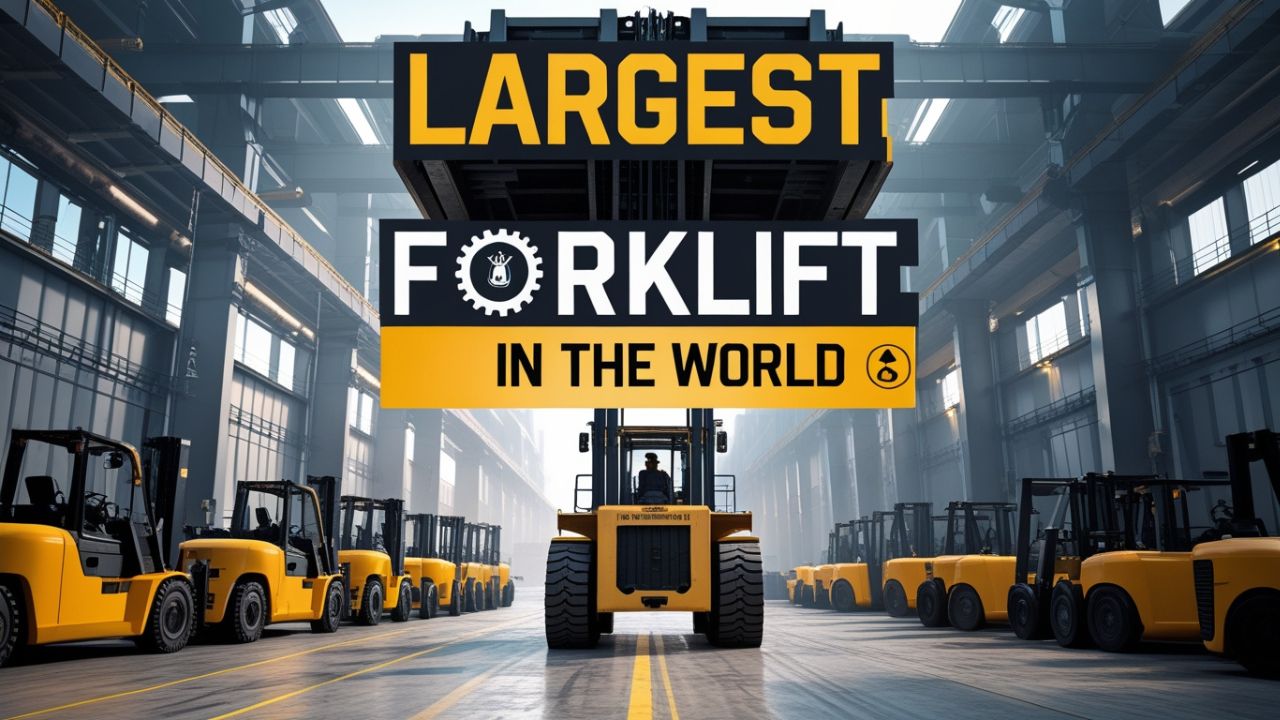
Meet the Largest Forklift in the World — You Won’t Believe Its Power!

You see them in ports and industrial zones. They look less like forklifts and more like building-sized robots. The largest forklifts in the world are built for one reason: to move the impossibly heavy stuff.
This isn’t about pallets of boxes. This is about shipping containers, steel coils, and wind turbine parts. We’re going to look at a few of the biggest models, compare what they do, and explain why you would need one.
What “Biggest” Really Means
When we talk about the “largest” forklift, we need to be specific. It can mean a few different things.
- Lift Capacity: This is the big one. It’s about how much weight the forklift can pick up. We measure this in tons.
- Physical Size: How tall and wide is the machine itself? Some are just massive.
- Lift Height: How high can it raise a load? This is crucial for stacking.
For this comparison, we’ll focus mainly on lift capacity. That’s usually what people are most curious about.
A Look at the Heavyweight Champions
Let’s compare a few of the most powerful forklifts out there. They each have a different specialty.
1. Kalmar DCG720-120: The Port Specialist
This machine is a common sight in busy shipping ports. It’s designed for one main job: moving shipping containers.
- Lift Capacity: 120 tons. That’s about 70 average cars.
- Key Feature: It has a specialized spreader attachment that locks securely onto containers. It’s built for precision, not just power.
- Best For: Port terminals and intermodal yards where containers are constantly being loaded and unloaded from ships and trains.
- The Reality: It’s incredibly efficient at its job, but you wouldn’t use it in a standard warehouse. It’s a specialist.
2. Taylor X-750: The Industrial Workhorse
If the Kalmar is a specialist, the Taylor is a brute. It’s the machine you find in steel mills and heavy equipment factories.
- Lift Capacity: 75 tons. Still an enormous amount of weight.
- Key Feature: It’s built with a strong, straightforward mast and a rugged frame. It’s designed to handle tough environments every day.
- Best For: Moving steel coils, large machinery parts, and construction materials. It’s the definition of a heavy-duty tool.
- The Reality: It’s less about high-tech finesse and more about raw, reliable power. It’s a tough machine for a tough job.
3. Fantuzzi FDC 150: The Record Breaker
This one pushes the limits. With a capacity that beats the others, it’s used for the truly unique projects.
- Lift Capacity: 150 tons. This is for lifting objects that most cranes would struggle with.
- Key Feature: Often has multiple axles and a complex suspension system to stay stable under such extreme weight.
- Best For: One-off mega projects, like placing a power plant generator or a massive section of a bridge.
- The Reality: This isn’t an everyday machine. It’s brought in for specific, record-breaking lifts.
How to Choose a Machine Like This
You don’t just buy one of these on a whim. The decision comes down to a few simple questions.
- What are you lifting? Is it always a standard container? Or is it odd-shaped industrial parts? The load determines the attachment and the truck’s design.
- Where are you using it? A port has different concrete and space than a steel mill. Maneuverability and ground stability are huge factors.
- How often will it run? A machine that runs 24/7 needs different maintenance and durability than one used for a single project. The total cost of ownership is a major factor.
The goal is to match the machine to the job. The most expensive or powerful option isn’t always the right one.
What’s Next for These Giants?
The future is about efficiency and control.
We’re starting to see more electric and hybrid models. This isn’t just for the environment. It can also mean lower fuel costs and less noise in ports.
Automation is also growing. Some ports now use automated guided vehicles (AGVs) that follow a set path. They can move containers without a driver, which can improve safety and workflow in a controlled area.
But the core job won’t change. We will still need immense power to move immense things.
The Bottom Line
These machines are incredible. But they are tools, not magic.
The Kalmar is the master of the port. The Taylor is the tough factory worker. The Fantuzzi is the specialist for the biggest lifts.
Choosing between them isn’t about which is “best.” It’s about which is the right tool for your specific, massive job.
Frequently Asked Questions (FAQ)
What is the highest capacity forklift ever built?
While standard models like the Fantuzzi FDC 150 handle around 150 tons, there have been custom, one-off forklifts built for specific industries that can lift even more. In the world of common manufacturers, capacities typically top out around this range.
Can these large forklifts lift their own weight?
Usually, no. A forklift might weigh 100 tons itself but be rated to lift 120 tons. The design and counterweight system are engineered specifically for the lift capacity, not to lift the machine’s own entire weight.
Why use a giant forklift instead of a crane?
It often comes down to speed and maneuverability in a crowded space. A forklift can often pick up, move, and place a load faster than a crane can in a busy yard or factory floor. It’s about choosing the right tool for the workflow.


